


Manchester Code Library
The mikroBasic PRO for AVR provides a library for handling Manchester coded signals. The Manchester code is a code in which data and clock signals are combined to form a single self-synchronizing data stream; each encoded bit contains a transition at the midpoint of a bit period, the direction of transition determines whether the bit is 0 or 1; the second half is the true bit value and the first half is the complement of the true bit value (as shown in the figure below).
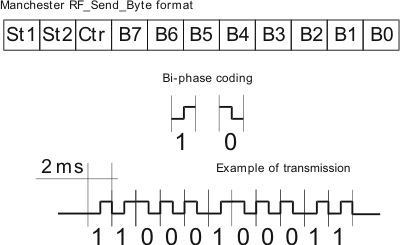
 Important :
- The Manchester receive routines are blocking calls (
Man_Receive_InitandMan_Synchro). This means that MCU will wait until the task has been performed (e.g. byte is received, synchronization achieved, etc). - Manchester code library implements time-based activities, so interrupts need to be disabled when using it.
External dependencies of Manchester Code Library
| The following variables must be defined in all projects using Manchester Code Library: | Description: | Example: |
|---|---|---|
dim MANRXPIN as sbit sfr external |
Receive line. | dim MANRXPIN as sbit at PINB0_bit |
dim MANTXPIN as sbit sfr external |
Transmit line. | dim MANTXPIN as sbit at PORTB1_bit |
dim MANRXPIN_Direction as sbit sfr external |
Direction of the Receive pin. | dim MANRXPIN_Direction as sbit at DDB0_bit |
dim MANTXPIN_Direction as sbit sfr external |
Direction of the Transmit pin. | dim MANTXPIN_Direction as sbit at DDB1_bit |
Library Routines
The following routines are for the internal use by compiler only:
- Manchester_0
- Manchester_1
- Manchester_Out
Man_Receive_Init
| Prototype |
sub function Man_Receive_Init() as word |
|---|---|
| Returns |
|
| Description |
The function configures Receiver pin and performs synchronization procedure in order to retrieve baud rate out of the incoming signal. Note :
In case of multiple persistent errors on reception, the user should call this routine once again or Man_Synchro routine to enable synchronization.
|
| Requires |
Global variables :
|
| Example |
' Initialize Receiver dim MANRXPIN as sbit at PINB0_bit dim MANRXPIN_Direction as sbit at DDB0_bit ... Man_Receive_Init() |
Man_Receive
| Prototype |
sub function Man_Receive(dim byref error as byte) as byte |
|---|---|
| Returns |
A byte read from the incoming signal. |
| Description |
The function extracts one byte from incoming signal. Parameters :
|
| Requires |
To use this function, the user must prepare the MCU for receiving. See Man_Receive_Init. |
| Example |
dim data, error as byte ... data = 0 error = 0 data = Man_Receive(&error) if (error <> 0) then ' error handling end if |
Man_Send_Init
| Prototype |
sub procedure Man_Send_Init() |
|---|---|
| Returns |
Nothing. |
| Description |
The function configures Transmitter pin. |
| Requires |
Global variables :
|
| Example |
' Initialize Transmitter: dim MANTXPIN as sbit at PINB1_bit dim MANTXPIN_Direction as sbit at DDB1_bit ... Man_Send_Init() |
Man_Send
| Prototype |
sub procedure Man_Send(tr_data as byte) |
|---|---|
| Returns |
Nothing. |
| Description |
Sends one byte. Parameters :
Note :
Baud rate used is 500 bps.
|
| Requires |
To use this function, the user must prepare the MCU for sending. See Man_Send_Init. |
| Example |
dim msg as byte ... Man_Send(msg) |
Man_Synchro
| Prototype |
sub function Man_Synchro() as word |
|---|---|
| Returns |
|
| Description |
Measures half of the manchester bit length with 10us resolution. |
| Requires |
To use this function, you must first prepare the MCU for receiving. See Man_Receive_Init. |
| Example |
dim man__half_bit_len as word ... man__half_bit_len = Man_Synchro() |
Man_Break
| Prototype |
sub procedure Man_Break() |
|---|---|
| Returns |
Nothing. |
| Description |
Man_Receive is blocking routine and it can block the program flow. Call this routine from interrupt to unblock the program execution. This mechanism is similar to WDT. Note :
Interrupts should be disabled before using Manchester routines again (see note at the top of this page).
|
| Requires |
Nothing. |
| Example |
dim data1, error, counter as byte

sub procedure Timer0Overflow_ISR org 0x12
  counter = 0
  if (counter >= 20) then
    Man_Break()
    counter = 0                ' reset counter
  else
    Inc(counter)                  ' increment counter
  end if
end sub

main:
  TOIE0_bit  = 1                   ' Timer0 overflow interrupt enable
  TCCR0_bit  = 5                   ' Start timer with 1024 prescaler

  SREG_I_bit = 0                   ' Interrupt disable

  ...

  Man_Receive_Init()

  ...

  ' try Man_Receive with blocking prevention mechanism

  SREG_I_bit = 1                   ' Interrupt enable
  data1 = Man_Receive(@error)
  SREG_I_bit = 0                   ' Interrupt disable

  ...

end.
|
Library Example
The following code is code for the Manchester receiver, it shows how to use the Manchester Library for receiving data:

program Manchester_Receiver

' Lcd module connections
dim LCD_RS as sbit at PORTD2_bit
    LCD_EN as sbit at PORTD3_bit
    LCD_D4 as sbit at PORTD4_bit
    LCD_D5 as sbit at PORTD5_bit
    LCD_D6 as sbit at PORTD6_bit
    LCD_D7 as sbit at PORTD7_bit

dim LCD_RS_Direction as sbit at DDD2_bit
    LCD_EN_Direction as sbit at DDD3_bit
    LCD_D4_Direction as sbit at DDD4_bit
    LCD_D5_Direction as sbit at DDD5_bit
    LCD_D6_Direction as sbit at DDD6_bit
    LCD_D7_Direction as sbit at DDD7_bit
' End Lcd module connections

' Manchester module connections
dim MANRXPIN as sbit at PINB0_bit
    MANRXPIN_Direction as sbit at DDB0_bit
    MANTXPIN as sbit at PORTB1_bit
    MANTXPIN_Direction as sbit at DDB1_bit
' End Manchester module connections

dim error_, ErrorCount, temp as byte

main:
  ErrorCount = 0
  Delay_10us()
  Lcd_Init()                          ' Initialize LCD
  Lcd_Cmd(_LCD_CLEAR)                 ' Clear LCD display

  Man_Receive_Init()                  ' Initialize Receiver

  while TRUE                          ' Endless loop
    Lcd_Cmd(_LCD_FIRST_ROW)           ' Move cursor to the 1st row
    while TRUE                        ' Wait for the "start" byte
      temp = Man_Receive(error_)      ' Attempt byte receive
      if (temp = 0x0B) then           ' "Start" byte, see Transmitter example
        break                         ' We got the starting sequence
      end if
      if (error_ <> 0) then           ' Exit so we do not loop forever
        break
      end if
    wend

    while (temp <> 0x0E)
      temp = Man_Receive(error_)      ' Attempt byte receive
      if (error_ <> 0) then           ' If error occured
        Lcd_Chr_CP("?")               ' Write question mark on LCD
        Inc(ErrorCount)               ' Update error counter
        if (ErrorCount > 20) then     ' In case of multiple errors
          temp = Man_Synchro()        ' Try to synchronize again
          'Man_Receive_Init()         ' Alternative, try to Initialize Receiver again
           ErrorCount = 0             ' Reset error counter
        end if
        else                          ' No error occured
          if (temp <> 0x0E) then      ' If "End" byte was received(see Transmitter example)
                                      ' do not write anymore received byte on Lcd
            Lcd_Chr_CP(temp)          ' else write character on Lcd
            Inc(ErrorCount)              ' Counts how many chars have been written on Lcd
            if ErrorCount = 25 then      ' If there were more then 25 characters
                                      ' synchronization is off
              Lcd_Cmd(_LCD_CLEAR)     ' Clear the Lcd of garbled communication
              temp = Man_Synchro()    ' Try to synchronize again
            end if

          else
            ErrorCount = 0               ' reset counter
          end if
            Delay_ms(25)
      end if

    wend                              ' If "End" byte was received exit do loop
  wend
end.
The following code is code for the Manchester transmitter, it shows how to use the Manchester Library for transmitting data:
program Manchester_Transmitter

' Manchester module connections
dim MANRXPIN as sbit at PORTB0_bit
    MANRXPIN_Direction as sbit at DDB0_bit
    MANTXPIN as sbit at PORTB1_bit
    MANTXPIN_Direction as sbit at DDB1_bit
' End Manchester module connections

dim index, character as byte
    s1 as char[17]

main:
  s1 = "mikroElektronika"
  Man_Send_Init()                 ' Initialize transmitter

  while TRUE                      ' Endless loop
    Man_Send(0x0B)                ' Send "start" byte
    Delay_ms(100)                 ' Wait for a while
    character = s1[0]             ' Take first char from string
    index = 0                     ' Initialize index variable
      while (character <> 0)      ' String ends with zero
        Man_Send(character)       ' Send character
        Delay_ms(90)              ' Wait for a while
        Inc(index)                ' Increment index variable
        character = s1[index]     ' Take next char from string
      wend
      Man_Send(0x0E)              ' Send "end" byte
      Delay_ms(1000)
  wend
end.
Connection Example
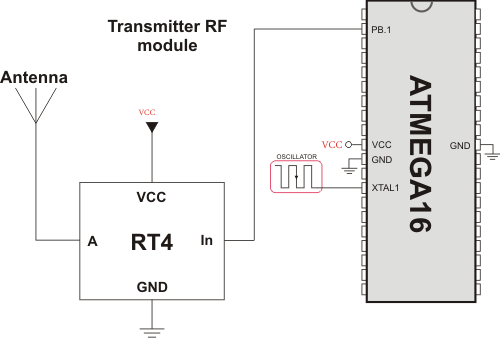
Simple Transmitter connection
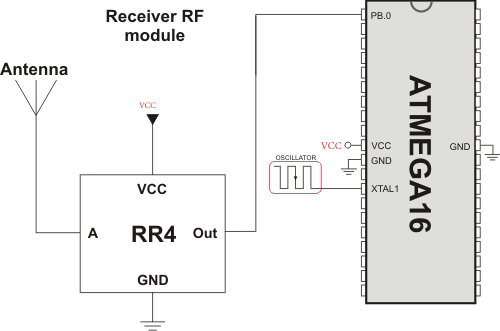
Simple Receiver connection
What do you think about this topic ? Send us feedback!
Find them on
